New research reveals relevance is the key to ad-supported growth

For years, digital media has wrestled with the balance between free content and paid subscriptions. Consumers say they dislike ads, yet few are willing to pull out their wallets to cover the cost of content themselves. In 2025, the conversation around monetization is coming into sharper focus: users increasingly recognize the value exchange that advertising enables.
To better understand users’ sentiment towards advertising, we surveyed 4,000 consumers in 2025 across the US and UK, compiling the results in our 2025 In-App User Privacy Report. The responses reveal a major shift in tolerance for ad-supported models as well as an active preference when the trade-off is clear. The challenge for us lies in making ads feel relevant, useful, and aligned with the experience at hand.
Why free still wins
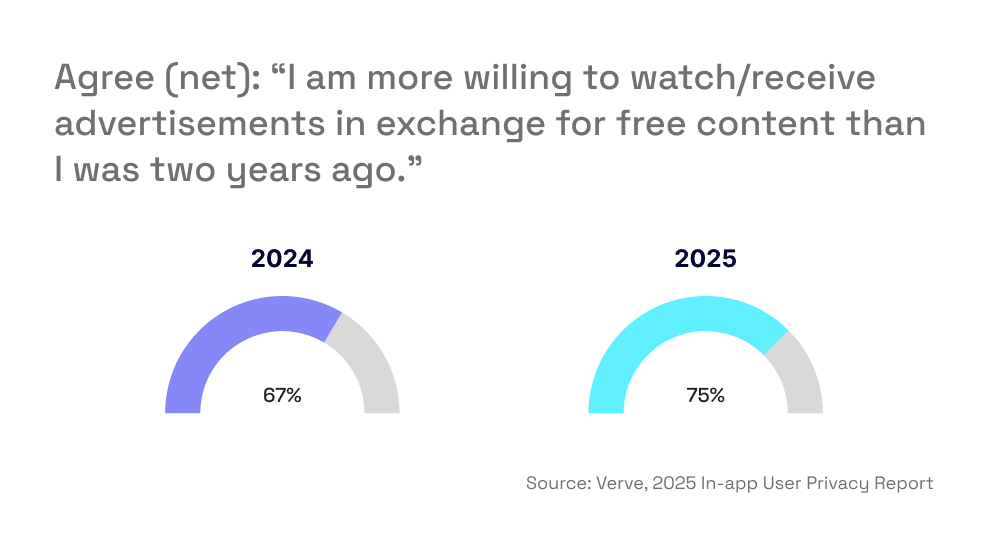
According to our survey, 75% of respondents are willing to accept ads in exchange for free content, up from 67% just a year ago.
But preferences on paper don’t always match real-world behavior. Only 7% of dating app users pay for premium features, and less than 2% of mobile gamers spend on in-app purchases. In reality, free (with ads) remains the default path for most users.
When asked about specific benefits, consumers consistently said they would rather watch an ad than pay. Whether it’s unlocking a feature, accessing content, or earning rewards, value-exchange models resonate strongly.
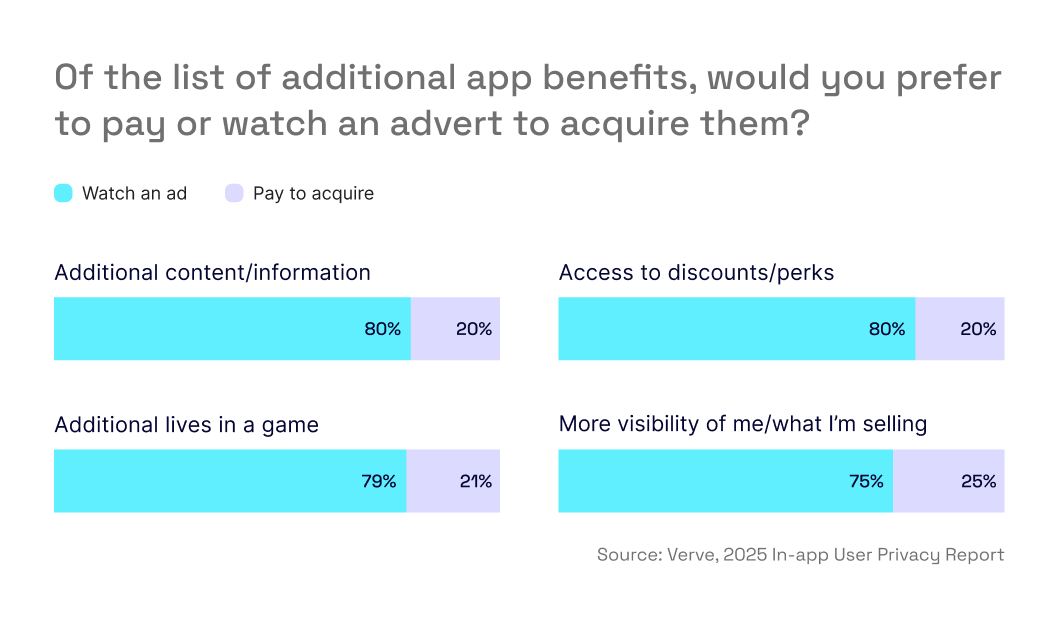
For the full list of benefits, download the 2025 In-app User Privacy Report.
This highlights the continued importance of rewarded ad formats, which give users a clear choice: watch an ad to gain something tangible. Far from being disruptive, these ads enhance the user experience with win-win moments where users get value, and publishers generate revenue.
Relevance is the game-changer
Of course, not all ads are created equal. The survey revealed that 72% of users are less likely to pay to remove ads if those ads are targeted and interesting.
In other words, relevance transforms ads into part of the experience. Personalized or contextually-aligned ads can spark product discovery, deliver discounts, and even improve brand perception.
These key findings regarding brand perception exemplify how context has evolved from a matter of preference to a determinant of trust:
- 49% of respondents said that ads mismatched to the app’s context (e.g., a beauty ad in a sports app) discourage engagement.
- 43% reported that such mismatches actually lower their perception of the brand.
- 48% said relevant, contextually aligned ads were the most appealing and most likely to drive engagement.
CTV leads the pack
Channel choice also matters when it comes to relevance. Connected TV (CTV) stood out as the most powerful environment for relevant ads, with 36% of respondents saying they are most likely to engage with them while streaming.

Mobile apps (28%) and mobile web (26%) remain strong, but CTV’s immersive format provides a unique advantage. The big screen commands attention, while cross-device integrations (QR codes, companion apps) make it easy for users to respond without friction.
For advertisers, this makes CTV a high-impact environment where relevance translates directly into engagement and measurable results.
Practical implications
For publishers
For publishers, the findings validate the sustainability of ad-supported monetization models. But the data also comes with a clear condition: relevance determines success. Users are receptive to ads that respect their time and the user experience.
Here’s how to accomplish this:
- Rewarded formats matter: Give users agency and tie ads to tangible value.
- Quality partnerships count: Work with platforms that can guarantee ad quality and contextual alignment.
- Fit is everything: Ads that feel native to the app environment enhance satisfaction, while poor fits risk churn.
For advertisers
The survey reinforces a simple truth: consumers reward relevance. Ads that align with context and user needs drive engagement, strengthen brand perception, and increase the likelihood of conversions.
But the flip side is equally important — misaligned placements can potentially damage trust. Nearly half of users penalize brands for poor contextual fit, making precision placement a brand safety issue as much as a performance one.
Strategic priorities for advertisers include:
- Prioritize contextual strategies: Deliver ads that fit seamlessly into the user’s environment.
- Lean into privacy-first targeting: Respect user boundaries while still ensuring relevance.
- Maximize high-impact environments like CTV: Harness the power of immersive screens to cut through noise and capture attention.
Relevance defines in the value exchanges
Today’s ID-less and contextual targeting capabilities are enabling the ad-supported model to grow stronger. Consumers have made it clear that they’re comfortable with ads, as long as the value exchange is obvious and the ads themselves feel relevant.
Ultimately, advertising has the potential to grow beyond a tool for funding content and become part of the experience. When done right, it adds value, builds trust, and strengthens brand relationships.
In 2025 and beyond, relevance is the currency of the value exchange. Those who master it will be the ones who win consumer attention and loyalty. For more data on these trends and more, download the 2025 In-app User Privacy Report.