Guide to in‑app bidding for mobile publishers
Advertising is a critical part of how many apps fund their growth. But connecting with advertisers efficiently hasn’t always been easy. For years, mobile publishers relied on waterfall setups that prioritized historical performance over real‑time demand, often leading to wasted impressions, lower revenue, and slower user experiences.
In‑app bidding was created to solve those problems. It brings real‑time competition, transparency, and efficiency directly into the app environment. This guide breaks down what in‑app bidding is, how it works, and why it has become the modern standard for mobile app monetization.
A brief history of mobile ad monetization
Before in-app bidding, most mobile apps monetized using a waterfall model. Let’s call this the Waterfall Era. In the Waterfall Era, publishers manually ranked ad networks based on historical eCPMs and set price floors. Each ad request was sent to partners one at a time until a buyer met the price. Here’s a visualization of what this process looked like:
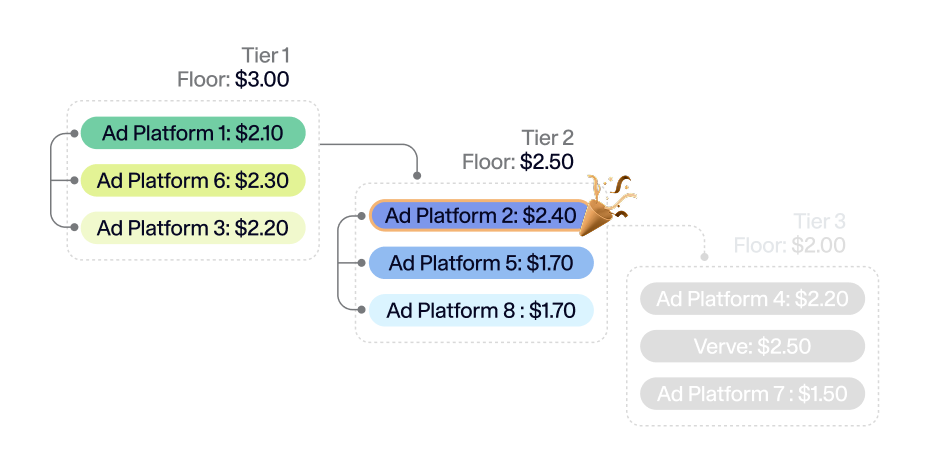
While simple, this approach created serious limitations:
- Revenue loss: Historical pricing often undervalued impressions.
- Limited competition: Buyers never competed simultaneously.
- Higher latency: Sequential requests slowed ad delivery.
- Low transparency: Publishers had little insight into true demand.
As mobile traffic scaled and programmatic demand increased, these inefficiencies became impossible to ignore.
What is in-app bidding?
In-app bidding is a programmatic auction model that allows multiple demand partners to bid on the same mobile ad impressions at the same time. The highest bid wins, and the ad is served instantly within the app.
Unlike waterfalls, in-app bidding is:
- Real-time: Every impression is valued dynamically.
- Simultaneous: All buyers compete equally.
- Transparent: Publishers see true market demand.
- Efficient: Faster auctions mean better user experience.
Because mobile apps don’t use HTML headers like websites do, bidding happens through SDKs and server-to-server integrations instead of JavaScript.
How in-app bidding works
At a high level, the process looks like this:
- An ad opportunity appears in the app.
- The app triggers a bid request to multiple demand partners.
- Buyers evaluate the impression and submit bids in real time.
- The highest bid wins the auction.
- The winning ad is rendered in the app.
All of this happens in milliseconds, ensuring ads load quickly without disrupting gameplay or user flows.
Key benefits of in-app bidding
Higher revenue through competition
By letting all buyers compete at once, in-app bidding ensures each impression is sold at its true market value. Publishers no longer rely on static price floors or guesswork.
Lower latency
Because auctions happen simultaneously, ad load times are faster compared to waterfall passbacks. This leads to a smoother user experience and higher engagement.
Fair access to demand
In-app bidding removes prioritization bias. Every demand partner gets the same opportunity to win an impression, opening the door to global and performance-driven advertisers.
Simplified monetization management
Publishers no longer need to constantly reorder waterfalls or manually optimize partner rankings. Optimization shifts from micromanagement to strategic performance tuning.
In-app bidding vs. Waterfall: A quick comparison
| Waterfall | In-app bidding |
|---|---|
| Sequential requests | Simultaneous auctions |
| Based on historical eCPMs | Based on real-time data |
| Higher latency | Faster ad delivery |
| Limited transparency | Full pricing visibility |
Industry adoption and momentum
In-app bidding is no longer experimental. It is the default monetization model for modern apps. Major platforms have publicly shifted away from waterfalls as bidding became the primary revenue driver.
As mobile advertising continues to grow, bidding provides the scalability and efficiency needed to support diverse formats such as rewarded video, interstitial ads, and native ads.
How publishers can get started
To implement in-app bidding successfully, publishers should:
- Work with platforms that support open, auction-based access to demand
- Monitor key metrics such as win rate, latency, and eCPM
- Diversify demand partners to reduce dependency on any single buyer
- Ensure SDK integrations are lightweight to protect app performance
The goal is not just higher revenue, but sustainable monetization that balances yield with user experience.
Why in-app bidding is the future of mobile advertising
Mobile advertising demands speed, fairness, and transparency. In-app bidding delivers all three by replacing guesswork with real-time intelligence. For publishers, it means stronger competition, cleaner auctions, and more predictable revenue. For advertisers, it means equal access to high-quality inventory at fair market prices.
As apps continue to be the primary gateway to digital experiences, in-app bidding stands as the foundation of modern mobile monetization. Not a trend, but a necessity.