Evolution of intent: How LLM intent data helps advertisers get ahead
Knowing what a consumer wants (and when) is the difference between a relevant ad and a wasted impression. But consumer intent itself has changed drastically now that the path to purchase often includes AI chat tools.
For two decades, search intent has been one of the most valuable tools in advertisers’ toolkits for understanding the customer journey — and for good reason. Google confirmed in 2025 that the search engine processed more than 5 trillion queries per year — that’s 13 billion searches per day.
Search intent remains crucial for effective advertising, but it doesn’t tell the full story now that conversational AI is in play. The performance edge for advertisers no longer comes from tracking the most users. It comes from reading signals others cannot see.
From search to conversation
AI chat platforms like ChatGPT, Gemini, Claude, and Perplexity are where many consumers turn when thinking through decisions both big and small, not just looking for a quick link.
Instead of typing “best eco-friendly SUV,” someone might ask an AI chat platform multiple questions that reveal nuanced priorities, constraints, and buying timelines. For example:
- “How can I reduce my carbon footprint?” → Environmentally conscious
- “What’s the most reliable hybrid for a family of four that mostly does highway driving?” → Busy parent with multiple kids
- “Are there still tax credits for EVs that apply to used cars?” → Price-aware on a deadline
This is conversational intent. It surfaces earlier in the buyer’s journey and carries far more context. Critically, it happens before a consumer ever reaches a traditional search engine or retail site. In this example, the pre-search conversational signals paint a much more detailed picture than “best eco-friendly SUV.”
| Traditional search intent | Conversational (AI) intent | |
|---|---|---|
| Format | Short keyword query | Natural-language question |
| Context revealed | General topic interest | Priorities, constraints, use cases |
| Typical buyer stage | Mid-funnel | Pre-search discovery |
| Signal richness | Low to moderate | High |
| Privacy considerations | Cookie/ID-based tracking | Opt-in consent, pseudonymized, aggregated insights |
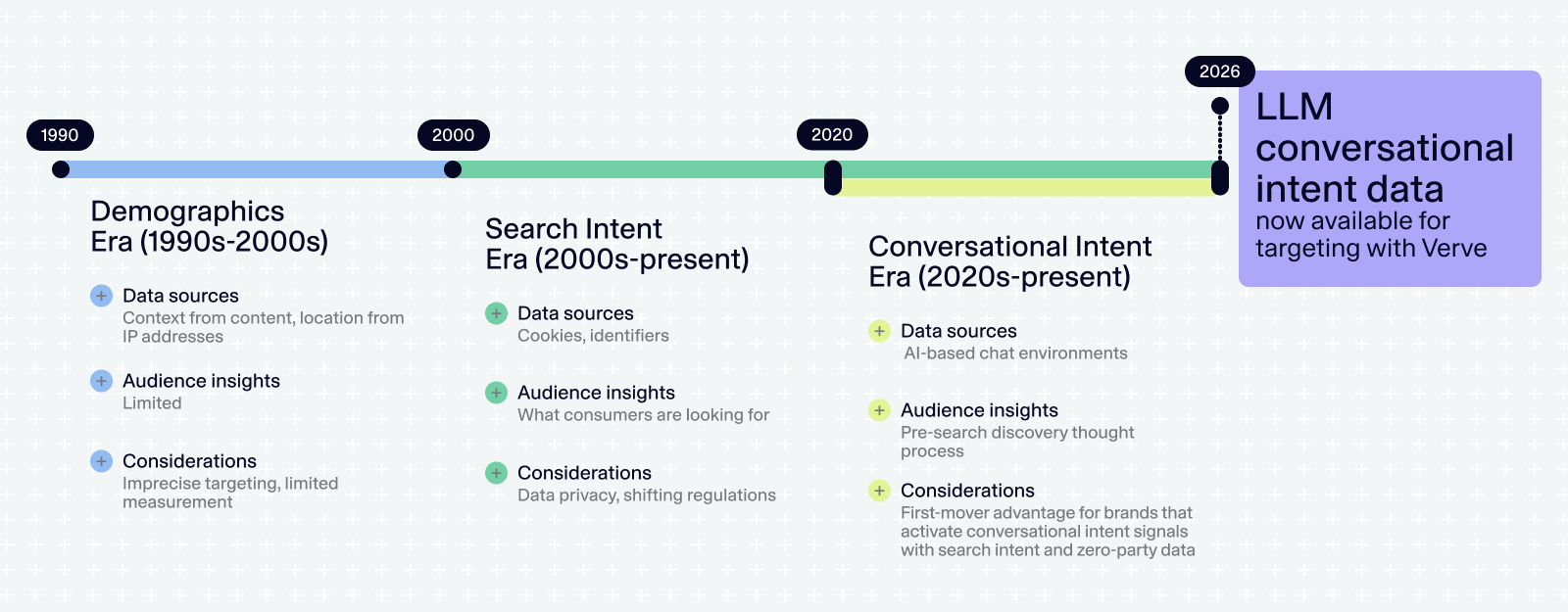
And this isn’t just a niche behavior. Adoption of AI chatbots is most pronounced among younger consumers, but LLM intent signals apply across demographics. According to the Pew Research Center, the majority of teens already use AI chatbots, and Emarketer forecasts 70% adoption in US adults aged 18-34 by 2029. For brands whose audiences skew younger, conversational intent signals are a present-day imperative.
Why the evolution matters for advertisers
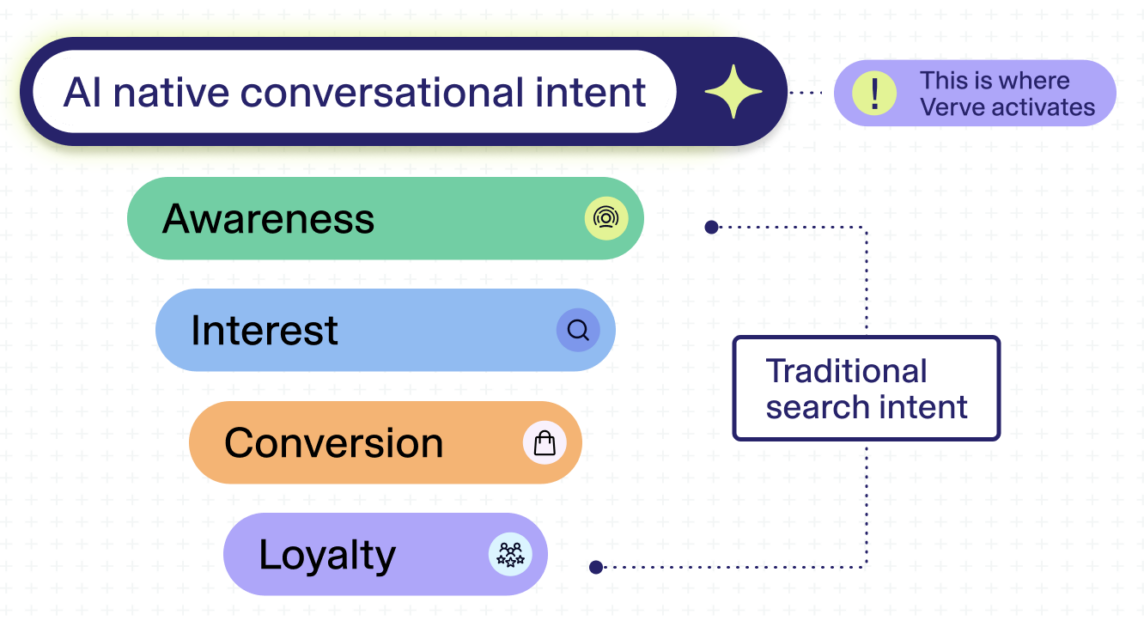
Search intent data reflects many important stages in the path to purchase — but conversational intent signals in AI chat environments happen even earlier. A consumer asking an AI chat tool for product recommendations is still very early in the exploration phase. They haven’t committed to a brand (or even a category) yet.
Advertisers have always wanted to reach consumers this early in the buying journey. Brands could build relevance before the decision narrows. They’d understand which concerns and priorities are driving consideration in their category.
But advertisers haven’t been able to use conversational intent data from LLM environments to inform targeting — until now.
Intent data from LLM integrations
Media buyers can now activate conversational intent signals for targeting at scale by working with Verve For Advertisers, the first ad tech platform with this capability. Here’s what that means in practice.
How does conversational intent data from LLMs work?
Media buyers don’t need to activate direct partnerships with the AI platforms to access these rich signals for targeting. Verve sources conversational signals from opted-in users who share AI chat activity through apps they already use. Signals flow from across major LLM-based AI environments, so there’s no dependency on any single provider.
All data is aggregated and pseudonymized before insights are derived. Brands receive modeled audience intelligence, not personal information. There is no one-to-one targeting.
The privacy design here is also a future-proofed performance advantage. Cookie-based targeting loses signal as identifiers degrade and consent rates decline. Conversational signals, built on explicit opt-in, don’t carry that fragmentation risk. And because signals are captured as consumers engage with AI tools, the intelligence arrives in real-time. Brands see interest patterns and emerging purchase intent as they surface, not weeks later through aggregated reports.
More signals. Even more opportunities.
Conversational intent signals are powerful. They’re even better when integrated with other data. Verve For Advertisers brings together multiple types of intent data into a single view for more effective targeting. This intelligence layer unifies zero-party, search intent, and AI chat signals to unlock scalable, AI-driven performance.
- Conversational signals come from opted-in users engaging with major LLM-based AI chat environments.
- Search intent data, sourced directly, tracks behavior across traditional search environments.
- Zero-party data from polling captures what consumers directly tell brands about their preferences and purchase plans.
No one signal gives the full picture. Combined, they show where a consumer is in their decision journey and what they’re likely to do next.
The scale
Verve processes over one billion events daily, drawing on signals from three million websites and apps representing two billion users worldwide. This means advertisers can scale their campaigns and drive outcomes from this high-quality intent data. Meanwhile, the conversational dataset grows every month as AI adoption expands. As of July 2025, OpenAI was already processing 2.5 billion queries each day for ChatGPT.
The structural shift is already underway
AI-based conversational intent data does not replace search intent. It extends it. Traditional search and AI chat will coexist, as many consumers still rely on browser-based search for specific lookups and navigation. The real advantage comes from layering multiple signal types: search intent shows where a consumer is in the funnel, and conversational signals show how and why they got there.
The dataset underlying conversational intent grows every time someone opens an AI chat tool to think through a decision. It’s happening billions of times a day, and the rate is accelerating.
Brands that build the capability to read those signals now will have sharper models, richer audiences, and more accurate predictions a year from today. Brands that wait risk missing out on a compounding advantage while their own data stack stays flat.
Getting started
Want to learn more about how to use LLM intent data for targeting? Check out the full announcement.