Winning the distracted viewer: Cross-screen strategy for the second-screen era

Let’s be honest, we’ve all been there: you turn on the newest season of that popular TV series, but after 5 minutes, you’re already distracted and doomscrolling on your phone. Suddenly, you hear an explosion and look up to realize that you have no idea what happened in the last 10 minutes. Oops.
Hollywood has taken note of this behavior and now adapts movies and shows to distracted viewers. While cinephiles lament this trend, advertisers should take note. Second-screen behavior creates unprecedented opportunities for engagement. By harnessing the potential of multitasking viewers, you can build effective cross-screen strategies that combine the best of both connected TV and mobile advertising.
What is second-screen writing?
Screenwriting is adapting to the distracted viewer, and “second-screen writing” is the term that has emerged to describe content that is designed to be understood without the viewer’s full attention. This includes simple plots, exposition dumps, and obvious dialogue.
This phenomenon recently hit news headlines when Matt Damon said in an interview that streaming platforms now tell filmmakers, “It wouldn’t be terrible if you reiterated the plot three or four times, and the dialogue, because people are on their phones while they’re watching.”
An analysis in the magazine n+1 further validates this claim. The author spoke to several Netflix screenwriters who often received feedback like “have this character announce what they’re doing so that viewers who have this program on in the background can follow along.”
The second-screen reality: By the numbers
What’s driving this second-screen writing phenomenon? We are.
According to EMARKETER, over 80% of US adults now use their phone or computer while watching TV.
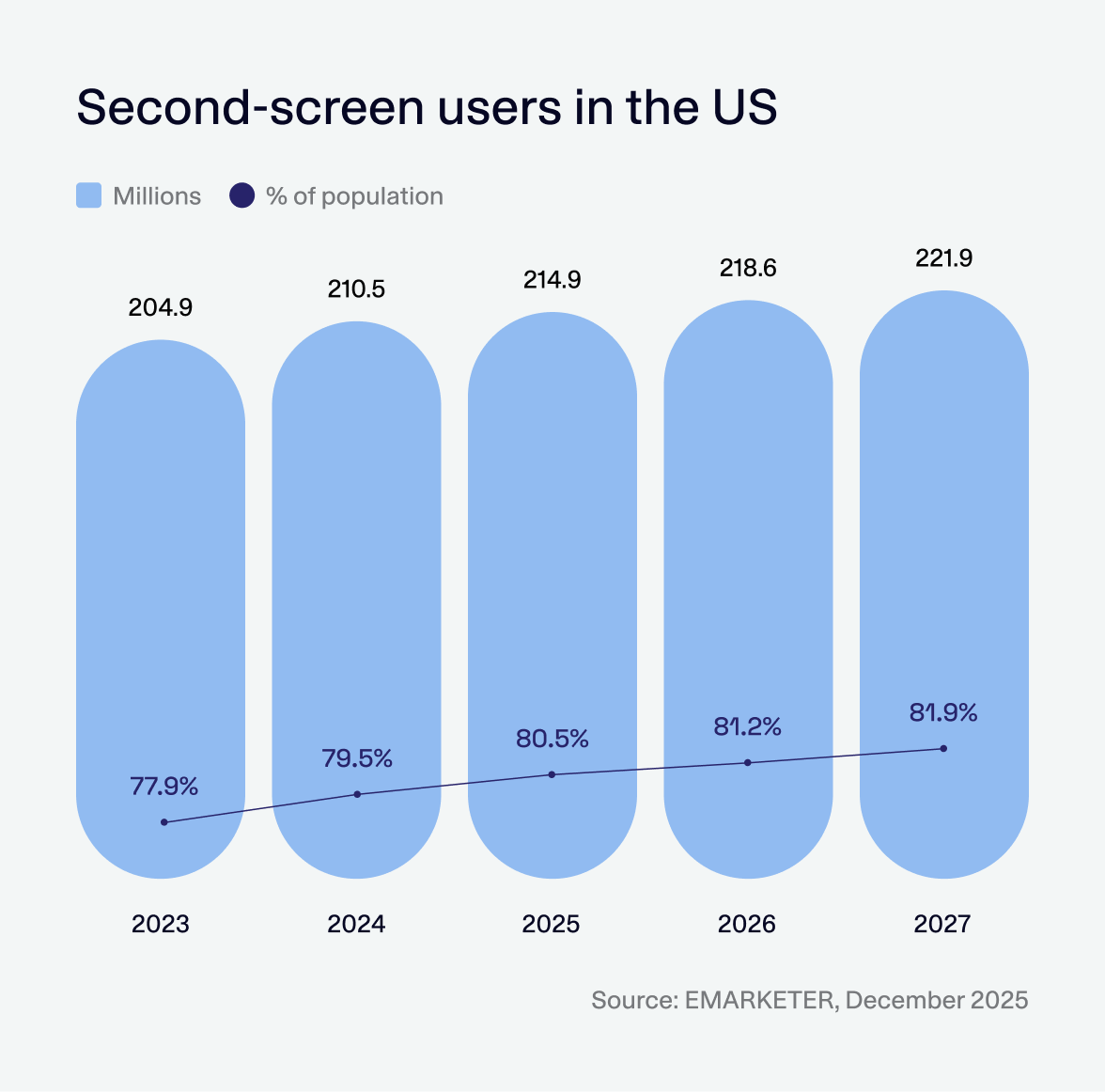
Our phone addictions, combined with the access we have to streaming platforms, have put immense pressure on content to be both attention-grabbing and easy-to-digest. And the irony for us in ad land is that TV’s increasing simplicity will further enable people to multitask…including looking at ads elsewhere.
Phone usage while watching TV is no different than any other time of day. People are checking social media, shopping, messaging, and gaming. Attention may be fragmented, but it’s predictable fragmentation. And this fragmentation is not a problem — it’s a feature.
This feature redefined advertising during this year’s Super Bowl, with many big brands opting out of the 30-second TV slots and opting instead for social campaigns. This is a decision backed by data. Over 65% of social media users watch TV as they scroll, and Horowitz Research found that 31% of TV viewers have shopped for products related to the show they’re watching using QR codes or shopping links during the show. You don’t need to spend $8 million to get a nation’s attention anymore.
Why this is gold for advertisers
So, if viewers are half-watching TV while scrolling on their phones, what does that mean for advertisers? Everything.
Mobile in-app: Capturing the wandering eye
Think about what happens during a commercial break or slow moment in a show. Viewers reflexively reach for their phones. Check socials, play a game, browse products. This isn’t a distraction from your ads; it’s an entry point.
Todd Segall, Senior Director of Media Sales, sees this dynamic clearly:
“The phone is actually the entry point into making CTV more of a lean-forward medium. There’s a real opportunity around sequential messaging and just following the consumer as they move from the television to the mobile device and back and forth.”
The key here is understanding the context. Sports fans scrolling during halftime are in a different mindset than reality TV viewers catching up on group chats. By aligning mobile campaigns with what people are watching, you create complementary touchpoints that feel natural rather than intrusive. A viewer watching a cooking show who sees a food delivery ad on their phone? That’s not an interruption. It’s timing.
CTV: The anchor screen
Meanwhile, CTV maintains its unique advantage: you can’t scroll past a CTV ad. Even if viewers are only half-paying attention, your message is still there, playing on the biggest screen in the room.
This actually makes high-impact creative more effective, not less. When viewers expect to multitask, bold visuals and clear branding can cut through the noise. They might glance up for only three seconds, but if your brand and message are unmistakable in that moment, you’ve won.
And here’s the real power move: frequency capping across CTV and mobile means you can reach viewers multiple times without potentially annoying them. One touchpoint on the TV, another on their phone. It feels like a natural media mix, not an assault.
The cross-screen sweet spot
The magic happens when you orchestrate both screens together. Sequential messaging (where a viewer sees your CTV ad, then encounters a follow-up on mobile) creates a narrative arc that reinforces your message without repetition. Even better: when viewers look up your brand on their phones after seeing your CTV spot, you’ve got targeting opportunities that are backed by demonstrated interest.
Alexei Moltchan, VP of Product, explains that this can also be a powerful user acquisition strategy:
“CTV ads run on a shared screen, but installs happen on personal devices. To prove CTV’s role, you need to configure your Mobile Measurement Platform (MMP) so household-level exposure can be associated with downstream actions using privacy-preserving cross-device methodologies […] The task for a UA marketer is to align the household’s viewing mindset with the app’s intent, using context as the bridge.“
The ID-less advantage
This brings us to the good news for privacy-conscious advertisers: you don’t need device IDs to make this work. Contextual and probabilistic targeting thrive in the second-screen environment because you’re working with observable patterns, not personal identifiers.
Viewers watching a particular show at a particular time are likely to exhibit similar mobile behaviors. You don’t need to know exactly who they are. You just need to know what they’re watching and when they’re likely to reach for their phones.
Practical takeaways for marketers
Ready to win the distracted viewer? Here’s how to start:
Design for divided attention. Your CTV creative needs to work even if someone only glances up twice. Strong visuals, unmistakable branding, and simple CTAs are non-negotiable. Assume viewers will miss your clever voiceover. Make sure the visuals tell the story.
Time your mobile campaigns strategically. Prime time isn’t just for TV anymore. Align your mobile inventory to complement TV viewing patterns: live sports, major streaming releases, binge-watching windows on weekends. Be where the phones are when the TVs are on.
Embrace the distraction. This is the big mindset shift: stop fighting for undivided attention and start building strategies around predictable fragmentation. Viewers will use their phones during your CTV ad. Plan for it. Benefit from it.
Test cross-screen attribution. The only way to prove this works is to measure it. Track how CTV exposure influences mobile behavior (and vice versa). The data will show you what Hollywood already knows: people consume media across screens, and the winners are the ones who meet them there.
tl;dr for the distracted reader
Second-screen writing is more than a Hollywood trend. It’s proof that audiences have fundamentally changed how they consume content. They’re not going back to undivided attention, and neither should your advertising strategy.
The opportunity here is massive. While some mourn the death of complex storytelling, advertisers can capitalize on the very behavior driving that change. Fragmented attention isn’t a bug; it’s a feature of modern media consumption.
So take a page from the screenwriters’ playbook: meet your audience where they are, make your message easy to grasp in a glance, and repeat it across the screens they’re actually using.
If Hollywood can’t beat distracted viewers, neither should you. Join them on both screens.