Your ad stack isn’t set-and-forget. Here’s how to keep it competitive.

You’ve picked your ad formats, set up your ad spaces, and stacked your networks. Finally time to sit back and let that ad revenue flow in, right? Wrong.
Today’s hypercasual games market is hypercompetitive. That means monetization can’t run on autopilot. It’s a growth engine that needs constant tuning, testing, and adapting to thrive. Our latest report, The Future of Casual Mobile Games, explores how top gaming publishers are optimizing their ad stacks. And many of these lessons also apply across the broader app ecosystem.
Here’s a sneak peek at what you’ll find in the report.
Don’t just stack demand. Diversify it.
Successful monetization requires strong demand. Publishers that depend too heavily on a single network leave money on the table and take on unnecessary risk. Diversifying your demand sources can increase auction competition, improve fill rates, and create pricing pressure that lifts eCPMs.
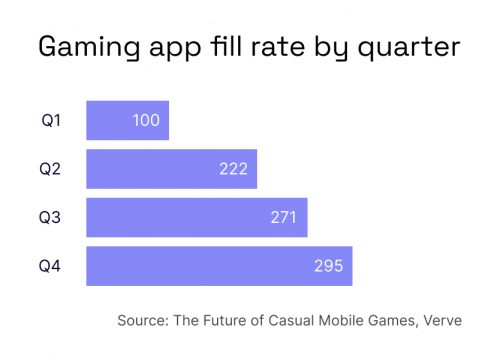
In one case study from The Future of Casual Mobile Games, a major casual gaming publisher revamped its demand stack by expanding its ads.txt entries and tapping into Verve’s network of 100+ DSPs. The result was a 122% fill rate increase in one quarter alone. And the lesson: every buyer you add (strategically) is an opportunity to reclaim undervalued inventory.

Optimize your price floors.
Floor pricing is a powerful level in the monetization toolkit. Too low, and you undervalue your inventory. Too high, and you price yourself out of auction.
The key is active floor optimization. By testing different floor levels by region, format, or audience segment, publishers can uncover how these changes affect fill rates and eCPM. Take DelightRoom for example: when Verve helped optimize price floors for their app Alarmy, ad revenue increased 54% over the course of one year.
Bottom line: your pricing model shouldn’t be static. It must evolve with your inventory and your audience.
Rethink refresh rates.
Banner and sticky ads might not be the trendiest ad formats, but they quietly deliver steady, incremental revenue — especially for puzzle and hypercasual games. Still, most publishers overlook one critical setting: refresh rate.
Leading game publishers are experimenting with lower refresh rates to boost viewability and yield without overwhelming players. A slower rotation often improves click-through rates and reduces latency, which improves UX.
If banners are part of your strategy (and they probably should be), take a look at your refresh logic. You might be showing too much, too fast.
Test, don’t guess.
A/B testing isn’t just for UI or IAP offers. Your ad stack should also be part of your experimentation culture. That includes:
- Testing layout changes (ad spacing, placements, density)
- Trying new formats like SKOverlay for iOS installs
- Optimizing frequency capping by player behavior or geography
Each experiment might not be a win, but every one gives you a signal. And in an era of signal loss, every insight counts.
Attract brand budgets.
Casual games have traditionally leaned into performance advertising. But brand budgets are increasingly eyeing gaming as a premium, high-attention channel — if the game can meet their standards.
Gaming apps can make themselves attractive to brands by supporting:
- IAB-compliant ad formats
- Open Measurement SDK (OM SDK) for transparent viewability tracking
- Brand-safe ad placements
- Contextual data and on-device signals for ID-less targeting
Publishers that can balance performance and brand demand stand to maximize yield without alienating players.
Think of monetization as a loop, not a launch.
The most successful mobile game publishers don’t wait for metrics to tank before making changes. They monitor trends, test frequently, and evolve their monetization strategy like they would their content roadmap. It’s not reactive. It’s embedded into how they operate.
And the results speak for themselves: in our report’s featured case study, the casual game publisher saw a 75% jump in ad revenue quarter-over-quarter.
Want the full playbook?
Actionable strategies, ad format insights, monetization trends — we cover all this and more in our latest report:
Download The Future of Casual Mobile Games now
Whether you’re optimizing for today’s formats or building a roadmap for a privacy-first future, this guide is your shortcut to smarter monetization.