Back to Basics: Guide to CTV/OTT advertising

Watching TV used to mean flipping through channels and sitting through endless commercial breaks. But those days are fading fast as audiences cut the cord in favor of streaming services — and advertisers are following suit.
OTT (over-the-top) and CTV (connected TV) have revolutionized how brands reach viewers, offering data-driven insights and innovative ad formats that traditional TV can only dream of. As the streaming landscape evolves, understanding how OTT and CTV advertising works — and how to make the most of them — is key to staying ahead.
In this guide, we’ll break down everything you need to know: the key features of these digital channels, user adoption, ad formats, and industry trends. Stay tuned!
OTT vs. CTV
Viewers today have more choices than ever, and so do advertisers. Linear TV refers to the traditional, scheduled programming delivered via cable, satellite, or broadcast networks. OTT refers to content streamed over the internet, most often via CTV. In short, OTT is the content, CTV is the device, and linear is the old-school way of watching TV.
What is OTT (over the top)?
OTT is an overarching category that encompasses any video streaming on the internet including on connected TV devices, mobile devices, computers, tablets, and gaming consoles. While some OTT and CTV content is streamed live, much of OTT and CTV are available on demand.
What is CTV (connected TV)?
CTV refers to any TV that streams video via the internet, whether it’s a smart TV with a built-in internet connection or a TV that connects separately through streaming sticks or gaming consoles. CTV is a device that streams OTT content.
Growth and adoption of OTT/CTV
Today’s “cord cutters” and “cord nevers” are causing the slow downfall of linear TV. This year will see the number of non-pay TV households surpass that of those with paid linear TV subscriptions.
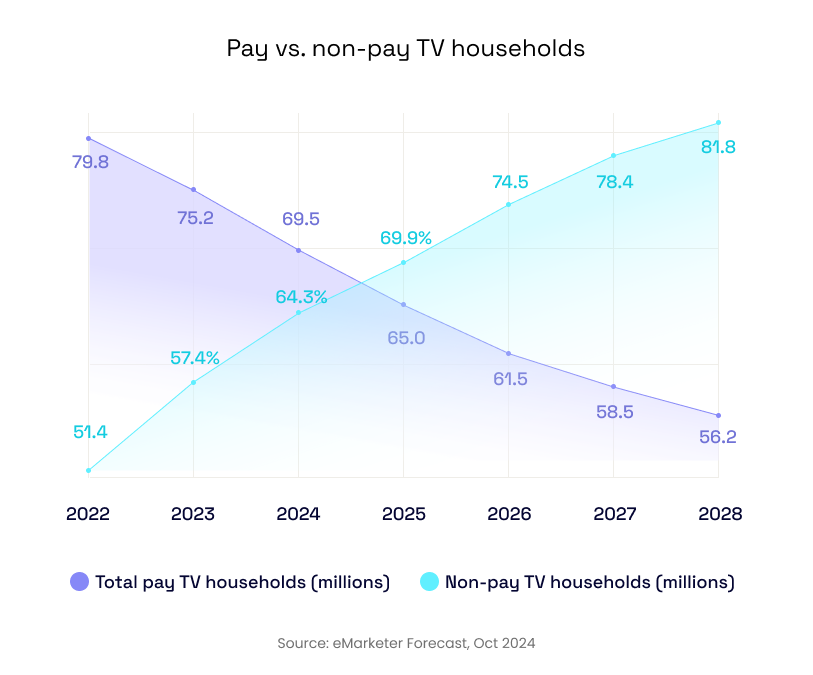
There are now 238 million CTV users in the US — that’s nearly 70% of the population. And the amount of time these users will spend watching CTV this year will come close to 3.5 hours.
OTT/CTV providers
OTT/CTV video streaming services can be supported in a few different ways: a subscription model, an ad-supported model, or through a hybrid approach.
SVOD, or subscription-supported video on demand, is supported via a monthly subscription fee. Subscribers pay in order to access a library of content (a classic example would be Netflix).
AVOD, or ad-supported video on demand, lets publishers monetize their content with advertisements while making content free to viewers. Ad-supported video on demand can feel like traditional linear TV advertising with its commercial breaks. FAST (free ad-supported streaming TV) is a popular subcategory of AVOD, with 117 million viewers in the US alone.
Hybrid models (i.e., ad-supported SVOD) include a mix of ad-supported video along with a (lower) subscription fee. An example would be a streaming service that offers a low subscription (or even free subscription) for ad-supported video streaming, but also gives viewers a chance to opt-in to a premium, ad-free subscription for a monthly fee. Some streaming platforms offer their own content ad-free, but play ads during licensed content.
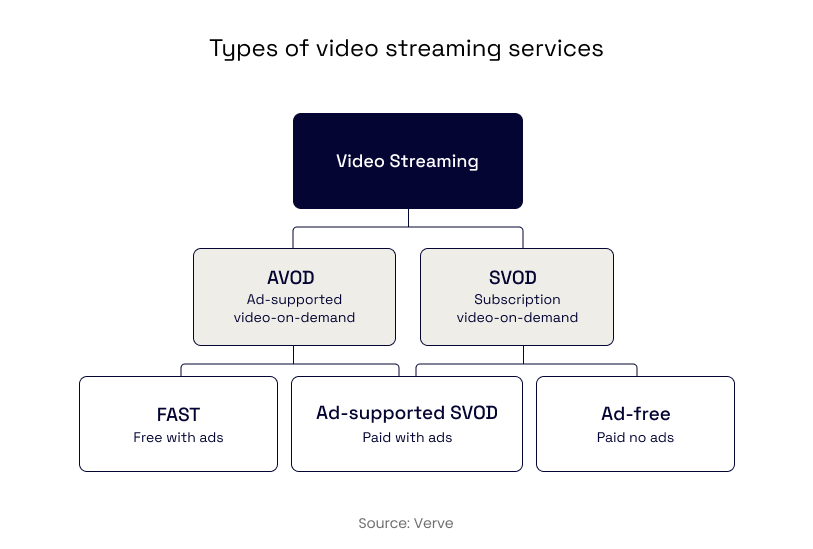
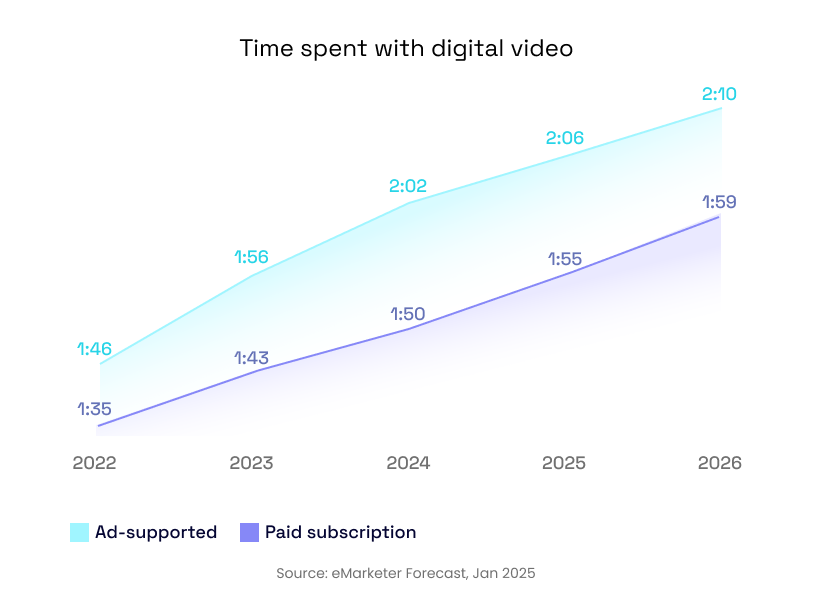
While all three types of video streaming services are currently booming, the growth of ad-supported models is outpacing that of subscription-based ones. This presents a huge opportunity for advertisers to grab the attention of their audiences while it’s on the big screen.
OTT/CTV ad insertion techniques
As advertisers look to maximize reach and engagement in the OTT and CTV space, the way ads are inserted into content plays a crucial role.
What are ad pods?
Ad pods are commercial breaks for OTT/CTV inventory. Ad pods are made up of ad slots, and play back to back ads just like traditional television. You can think of an ad pod simply as an ad break.

What are ad slots?
Ad slots are individual ad placements within an ad pod. They can vary in length. An ad pod is made up of multiple back-to-back ad slots.
Since ad pods are made up of multiple ad slots, CTV publishers have multiple opportunities to monetize their inventory, which increases the value of their ad breaks.
OTT/CTV advertising trends
The OTT and CTV landscape is evolving at a rapid pace, driven by shifting viewer habits, advancements in ad technology, and growing advertiser demand for premium digital video inventory. As cord-cutting accelerates and streaming platforms continue to expand, brands are recognizing the value of OTT and CTV as essential components of their media strategies.
The result? CTV ad spending is seeing double-digit annual growth, with over $33 billion total spent on CTV advertising in the US alone.
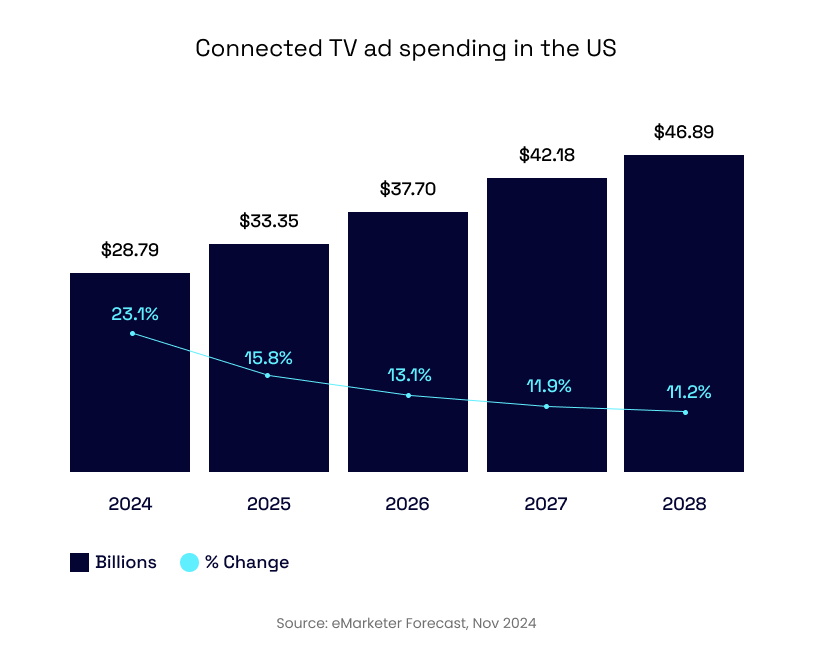

Advertisers value CTV because it provides a premium, brand-safe environment for delivering high-impact ads. As more and more brands get into CTV, programmatic direct deals will grow in popularity as a method for purchasing this premium inventory. These pre-packaged deals offer advertisers curated CTV inventory with precision targeting to reach their campaign goals.
OTT and CTV advertising presents dynamic opportunities for brands to connect with audiences in innovative ways. Staying informed about industry trends and adopting best practices will be crucial for success in this evolving landscape. From ID-less ad targeting to new measurement solutions, the future of OTT/CTV advertising is full of opportunities.
Frequently asked questions
CTV (connected TV) and OTT (over-the-top) are related but distinct concepts in streaming advertising:
OTT (over-the-top) is the broader category referring to any video content streamed over the internet, bypassing traditional cable or satellite TV providers. OTT content can be watched on multiple devices including:
- Connected TVs and smart TVs
- Mobile phones and tablets
- Desktop computers and laptops
- Gaming consoles
CTV (connected TV) is a subset of OTT that specifically refers to television devices that stream internet content. CTV is the device; OTT is the content delivery method.
Think of it this way:
- OTT = what (the streaming content and delivery method)
- CTV = where (the TV screen/device)
Example: When you watch Netflix on your smart TV, you’re consuming OTT content via a CTV device. When you watch that same Netflix show on your phone, you’re still consuming OTT content, but not on CTV.
For advertisers: OTT advertising reaches audiences across all streaming devices, while CTV advertising specifically targets the premium big-screen TV viewing experience. CTV typically commands higher ad rates due to the larger screen size, longer viewing sessions, and lean-back living room environment.
OTT (over-the-top) advertising refers to video ads delivered through streaming content on internet-connected devices including connected TVs, mobile devices, tablets, computers, and gaming consoles. Unlike traditional TV commercials, OTT ads reach cord-cutters and cord-nevers who consume content through streaming services rather than cable or satellite. These ads can appear in AVOD (ad-supported video on demand), FAST (free ad-supported streaming TV), or hybrid streaming models.
How OTT advertising works:
- Ad request: When a viewer streams content, the platform sends an ad request to an ad server
- Real-time auction: Advertisers bid programmatically for the ad placement based on audience targeting parameters
- Dynamic ad insertion: The winning ad is inserted into the content stream within ad pods (commercial breaks)
- Performance tracking: The ad server tracks impressions, completion rates, and engagement metrics
OTT platforms use programmatic technology to target audiences based on demographics, viewing behavior, device type, and contextual signals—all in privacy-first environments without relying on personal identifiers.
CTV (connected TV) advertising is video advertising delivered specifically on television screens—either smart TVs with built-in internet connections or traditional TVs connected through streaming sticks, gaming consoles, or set-top boxes. CTV is a subset of OTT advertising, focusing exclusively on the big-screen viewing experience rather than mobile or desktop devices.
How CTV advertising works: CTV ads follow the same programmatic process as OTT: streaming platforms send ad requests, advertisers bid in real-time, and winning ads are dynamically inserted into content during commercial breaks (ad pods). The key difference is the premium, brand-safe environment of the television screen, which offers higher engagement and attention compared to smaller devices.
CTV advertising provides advanced targeting and measurement capabilities similar to digital advertising, but with the impact and credibility of traditional television.
CTV advertising and programmatic video advertising overlap but aren’t identical:
CTV advertising is a device-based category that specifically refers to video ads delivered on connected television screens—smart TVs, streaming sticks (Roku, Fire TV), gaming consoles, and set-top boxes. It focuses on the big-screen, lean-back viewing experience in living rooms.
Programmatic video advertising is a buying method that uses automated technology to purchase video ad inventory across any device — CTV, mobile, desktop, and tablets. It includes:
- In-stream video (ads within video content)
- Out-stream video (ads on websites outside video players)
- Social video ads
- Mobile app video
Key distinction: CTV describes where the ad appears (on TV screens), while programmatic describes how it’s bought (automated, data-driven bidding).
The overlap: Most CTV advertising today is bought programmatically, making it a subset of programmatic video. However, not all programmatic video is CTV. Programmatic also includes mobile and desktop video inventory.
OTT advertising can be purchased through several methods:
Programmatic platforms: Use demand-side platforms (DSPs) to buy OTT inventory programmatically with automated bidding, real-time optimization, and cross-platform reach. This is the most common method for efficiency and scale.
Programmatic direct/PMP deals: Access curated, pre-packaged OTT inventory through private marketplace deals with guaranteed impressions, premium placements, and brand-safe environments. These deals are growing in popularity for CTV specifically.
Direct deals: Work directly with streaming platforms or publishers to secure premium inventory through insertion orders, often for exclusive placements or sponsorships.
Advertising networks: Partner with OTT ad networks that aggregate inventory across multiple streaming services for simplified buying and broader reach.
Most advertisers combine programmatic buying for scale with direct deals for premium placements, allowing them to reach audiences efficiently across multiple streaming platforms. Verve is a trusted CTV buying platform. Get in touch to learn more.
The ideal frequency for OTT advertising typically falls between 3-5 exposures per viewer over a campaign flight. Research shows:
- 1-2 exposures: Builds initial awareness
- 3-5 exposures: Optimal for brand recall and consideration without ad fatigue
- 6+ exposures: Risk of diminishing returns and viewer annoyance
However, ideal frequency depends on campaign goals:
- Brand awareness campaigns: 2-4 exposures often sufficient
- Direct response campaigns: 5-8 exposures may be needed for lower-funnel actions
Best practices:
- Use frequency capping across CTV and mobile to control exposure
- Monitor video completion rates (significant drops indicate over-exposure)
- Test different frequencies and measure impact on key metrics
- Coordinate frequency across screens to avoid saturation while maximizing reach
Common CTV advertising formats and examples include:
Ad placement types:
- Pre-roll ads: 15-30 second video ads before content starts (e.g., before a Hulu episode)
- Mid-roll ads: Commercial breaks during content, similar to traditional TV (e.g., ads during YouTube TV or Peacock programming)
- Post-roll ads: Ads after content ends (less common, lower engagement)
Interactive formats:
- QR code ads: Overlays that viewers scan with phones for instant engagement
- Shoppable ads: Direct product purchases through TV interface on select platforms
- Voice-activated ads: Smart TV integration for voice responses
Industry examples:
- Automotive: High-impact 30-second car launch videos showcasing features
- CPG/Food delivery: App download campaigns with promo codes
- Entertainment: Movie trailers and show promotions on streaming platforms
- DTC brands: E-commerce and app install campaigns with QR codes
- Live sports: Real-time ad insertion during streaming sporting events
Tracking CTV ad performance requires multi-touch attribution and cross-device measurement strategies:
Engagement metrics:
- Video completion rate (VCR): Percentage of viewers who watch the entire ad
- Quartile completion: Tracking at 25%, 50%, 75%, and 100% completion
- Time spent viewing: Average watch time per impression
- Interactive engagement: QR code scans, clickable overlay interactions, voice command usage
Conversion tracking methods:
Pixel-based tracking: Track website visits and conversions after CTV exposure using probabilistic matching and household-level IP address attribution
Mobile measurement partners (MMPs): Attribute app installs and in-app actions to CTV campaigns through cross-device matching
Lift studies: Measure incremental impact on brand awareness, search behavior, website traffic, or sales compared to control groups
Household-level tracking: Match CTV ad exposure to online activity at the household/IP level without individual user tracking
Promo codes: Use unique CTV-specific codes or URLs to track direct response and measure attribution
ACR (Automatic Content Recognition) data: Leverage smart TV data to understand viewing behavior and correlate with conversion events
ID-less attribution: Modern platforms use contextual signals, behavioral patterns, and probabilistic modeling rather than relying on device IDs. This is critical for privacy-compliant measurement.
Best practice: Use multi-touch attribution models that account for CTV’s role in the customer journey, often as an upper-funnel awareness driver that influences lower-funnel conversions on other devices — for example, using CTV ads to drive mobile user acquisition.
Traditional CTV ads are not directly clickable like mobile or desktop ads, since TV remotes don’t function like computer mice or touchscreens. However, CTV advertising is rapidly evolving with interactive formats that bridge this gap:
Interactive CTV ad formats:
QR codes: The most common interactive element—viewers scan with smartphones to visit landing pages, redeem offers, or download apps. Highly effective for driving measurable actions.
Voice commands: Smart TV integration (Alexa, Google Assistant) allows voice-activated responses to ads for more information or purchases.
Shoppable ads: Some platforms enable direct product browsing and purchases through the TV interface using remote controls (limited availability).
Second-screen experiences: Ads prompt simultaneous mobile engagement—viewers use phones to interact while watching on TV.
Remote clickability: Newer smart TV platforms are testing limited remote-based navigation for simple actions.
Strategic implications: While true clickability remains limited, these interactive formats enable CTV campaigns to drive measurable direct response. Most successful CTV strategies focus on upper-funnel goals (awareness, consideration) while using mobile retargeting and interactive elements to capture lower-funnel conversions. The combination of big-screen impact with mobile interactivity creates powerful cross-screen engagement.